★★★★★
★★★★★
Verified Buyer
Correct order and speedy delivery!
Verwendung: Dieses Produkt ist ausschließlich für Forschungszwecke bestimmt.
Alle Produktinformationen auf dieser Website dienen ausschließlich Bildungszwecken. Jede Form der Einbringung in den Körper von Menschen oder Tieren ist gesetzlich streng verboten. Dieses Produkt darf nur von zugelassenen und qualifizierten Fachleuten gehandhabt werden. Es ist kein Arzneimittel, Lebensmittel oder Kosmetikum und darf nicht als solches gekennzeichnet, verwendet oder falsch etikettiert werden.
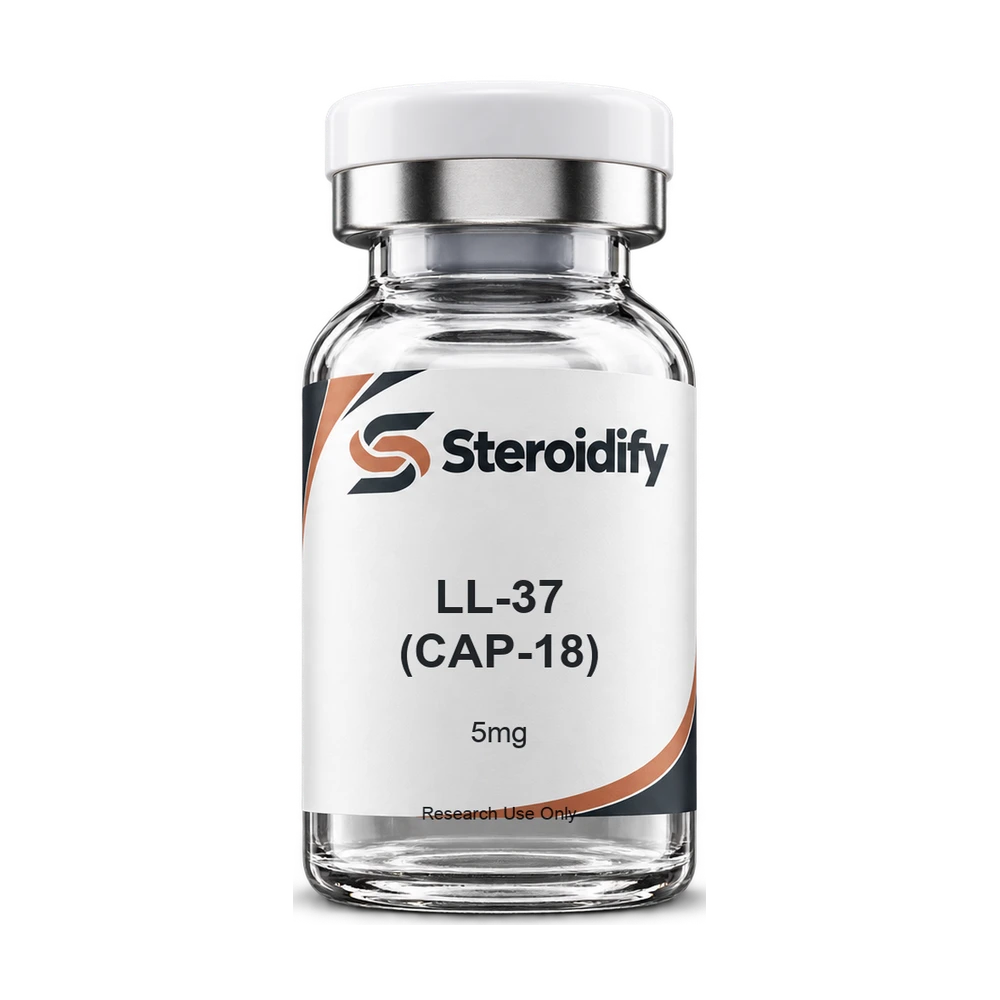
LL-37 (CAP-18) is the active C-terminal peptide derived from human cathelicidin, the sole cathelicidin-family antimicrobial peptide encoded in the human genome.
Während der Umstellung unserer Verpackung erhalten Sie möglicherweise Produkte mit dem bisherigen oder dem neuen Etikett. Formulierung, Reinheit und Qualität bleiben nach unseren Standards genau gleich.
-25% auf alles – bis 31. Oktober
25% auf reguläre Preise statt anderer Angebote. Nur mit dem Krypto-Zahlungsrabatt kombinierbar.
Jede Charge wird auf Reinheit, Wirksamkeit und Qualität geprüft.
Laborergebnisse ansehen →LL-37 (CAP-18) is the active C-terminal peptide derived from human cathelicidin, the sole cathelicidin-family antimicrobial peptide encoded in the human genome. Research interest centers on its dual function as both a direct membrane-disrupting antimicrobial agent and an immunomodulatory signalling molecule engaging multiple receptor pathways.
Research applications include innate immune signalling studies, antimicrobial peptide membrane-interaction research, and formyl peptide receptor (FPR2) pathway investigation.
| Chemical Formula | C205H340N60O53 |
|---|---|
| Synonyms | Cathelicidin, ropocamptide, Bac4, Cathelicidin antimicrobial peptide 18 |
| Molar Mass | 4493 g/mol |
| CAS Number | 154947 |
| PubChem CID | 16198951 |
| Total Compound Content | 5mg (1 vial) |
| Shelf Life | 36 months |
Every batch is independently lab tested for identity, purity and potency. View our lab testing program →
LL-37's antimicrobial mechanism involves direct insertion into and disruption of bacterial cell membranes via its amphipathic alpha-helical structure, a mechanism studied using model lipid bilayer and liposome leakage assays.
Separately, LL-37 engages host cell surface receptors — including FPR2, P2X7, and EGFR transactivation pathways — to modulate immune cell chemotaxis, cytokine release, and cell migration, representing a receptor-mediated signalling mechanism distinct from its direct membrane-disrupting antimicrobial action.
Research distinguishing these two activities typically uses peptide fragments or receptor antagonists to isolate which mechanism drives a given experimental endpoint.
Standard approaches include transwell migration assays to quantify LL-37-induced chemotaxis of neutrophils, monocytes, or mast cells, alongside cytokine/chemokine release assays (ELISA, multiplex) following LL-37 exposure in immune cell culture models. FPR2-specific signalling is often confirmed using selective FPR2 antagonists or receptor-knockdown approaches to establish receptor dependence of the observed chemotactic or signalling response.
Model lipid bilayer systems — including liposome dye-leakage assays, planar lipid bilayer electrophysiology, and circular dichroism spectroscopy to monitor peptide secondary structure upon membrane association — are standard biophysical methods for characterising LL-37's membrane interaction and permeabilisation kinetics. These methods allow researchers to correlate peptide concentration, lipid composition (mimicking bacterial versus mammalian membranes), and resulting membrane disruption, providing mechanistic insight into the peptide's selectivity for bacterial over host cell membranes.
Correct order and speedy delivery!
excellent product was shipped very fast Love it
Very happy with the product and the people. Professional !!
Highly satisfied with the product quality. Will order again soon.
The experimental results were exceptional. Absolutely thrilled with the fast turnaround times, it's an exceptionally pure batch. Highly satisfy and will return.
Truly happy with the ordering process and quality was great and dispatch was incredibly fast. We got fantastic research results. Will purchase again soon.
Super happy with the prompt communication, purity exceeded my expectations. We got fantastic research results. Highly satisfied customer.
The experimental results were exceptional. Top-notch quality from the service. In addition, the chemical quality is top notch. Highly satisfied customer.